
Landscape Genomics and Local Adaptation
My work in landscape genomics asks how widespread tree species adapt to environmental variation across large geographic ranges.
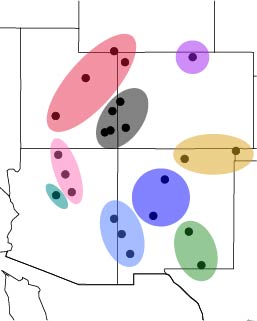
How is genetic variation distributed across landscapes?
Widespread forest trees experience different climates, soils, and environmental pressures across their ranges. I use landscape genomics to examine how genomic variation is structured across environmental gradients and what these patterns reveal about local adaptation in pinyon pine species.
Which traits are linked to adaptation?
I integrate genomic data with functional and reproductive traits, including seed production frequency and magnitude, leaf traits such as stomatal traits, leaf area, and intrinsic water-use efficiency, and seed traits such as seed size, seed number, and viability. This approach links genetic variation to traits that influence persistence, reproduction, and potential responses to climate change.
How can natural history collections support genomics?
A major goal of this work is to build tools and resources for non-model forest trees. This includes transcriptome resources, tissue-specific expression data, voucher specimens, and repositories that connect SNPs, traits, and museum specimens. Natural history collections are essential because they preserve the biological context needed to link genomic data to plants, places, and traits over time.
How can genomics inform restoration?
By connecting genomic variation, traits, and environmental gradients, this research can help inform seed sourcing, restoration, and reforestation strategies for long-lived forest species facing rapid environmental change.