Forest Resilience and Regeneration
My work in forest resilience and regeneration asks how climate, species traits, and ecological context shape the processes that allow forests to persist.
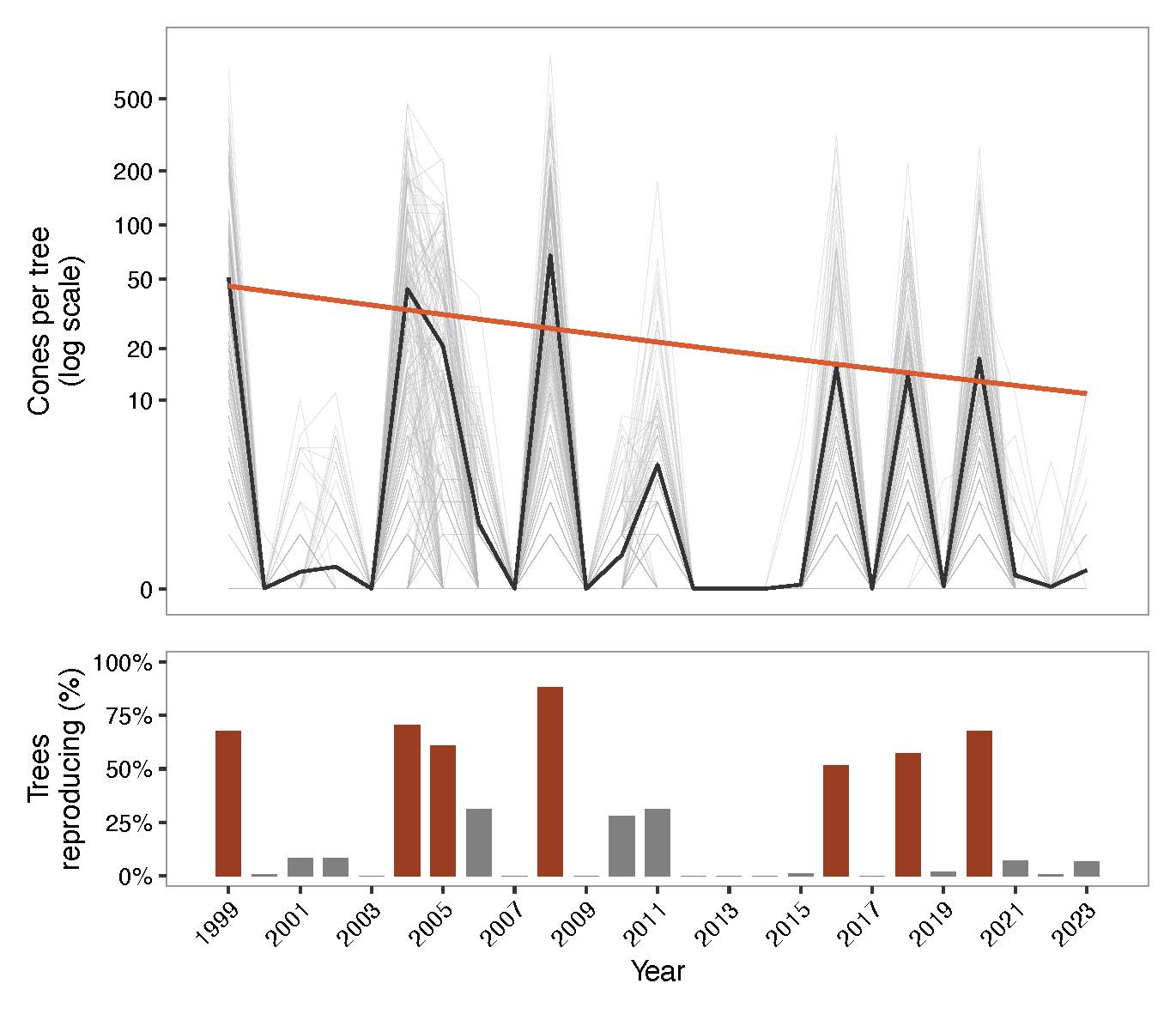
What controls seed production across years?
Seed production is highly variable through time, and this variability can influence plant fitness, population dynamics, and range shifts. I use long-term ecological datasets to examine how climate and environmental drivers shape seed production across species, sites, and years.
When does seed production lead to recruitment?
Tree regeneration depends on a rare sequence of events: seed production, germination, seedling establishment, and survival. My research examines how these stages align under changing climate conditions, with a focus on recruitment under increasing drought and climatic variability.
Do ecological patterns change across scales?
I am especially interested in how relationships between climate, traits, and seed production shift depending on the scale of analysis. In long-term, multi-species datasets, patterns can differ when examined across all species and sites, among species within sites, or within species across environmental gradients. This scale dependence matters for understanding when broad ecological patterns reflect shared environmental responses, species traits, or local evolutionary histories.
Together, this work contributes to broader questions about forest persistence, range shifts, and population dynamics under global change.